
Theory of Liberation
Core Analysis

In order to intervene against the misuse and cooptation of the healing justice framework, we need to define what healing justice means to us. Drawing on the work of Healing Justice Lineages — an anthology and digital archive stewarded by NQTTCN founder Erica Woodland and Healing Justice co-architect Cara Page — NQTTCN’s core analysis is as follows. HJ is:
- anti-capitalist and abolitionist.
- an intervention to disrupt the medical industrial complex: Healing Justice is not possible without a strong analysis of and commitment to disrupting all carceral care interventions as well as the following movements and frameworks: disability justice, environmental justice, harm reduction, reproductive justice & transformative justice.
- a requirement for revolutionary change: Our movements for liberation have always included strategies for care, protection, safety, and healing. Healing Justice is a requirement for our collective liberation.
- a call for practitioners to take their role in movement: Health and healing practitioners can and should learn to organize. They have a role to play in both movement building as well as structural interventions in the medical industrial complex. There is a rich history of practitioners holding inside/outside strategies in political liberation work.
- a strategy for movements & practitioners to transform trauma: Our movements require politicized health and healing practitioners as well as organizers committed to transforming trauma and its impacts on our liberation movements.
Our Strategies
Our core interventions were developed by deepening our understanding of the needs of our collective care and safety ecosystem. For us, it was important to treat these interventions as experiments to maximize resources and remain agile and adaptive in a constantly shifting socio-political landscape. In the spirit of experimentation, we take on bold new practices with the ability to engage in real assessment of our work and impact.
NQTTCN’s healing justice interventions are designed to build abolitionist ecosystems of care for and by QTBIPOC. Our strategy centers three core interventions:
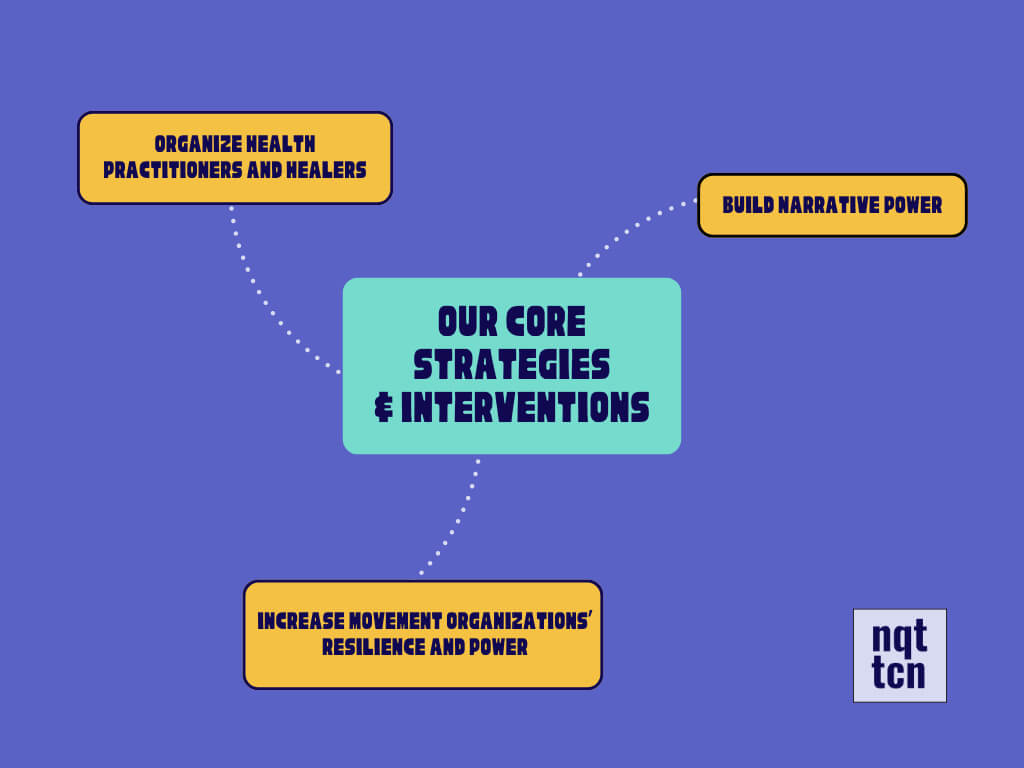
- Organizing QTBIPOC healing practitioners through a membership model to develop their political analysis and engage in movement building;
- Equipping social justice movements with care and safety strategies to sustain campaigns, address trauma, and confront state violence; and,
- Building narrative power to protect the spiritual and political roots of healing justice and counter its cooptation.
These interventions are community-powered experiments in transforming the conditions under which we live, work, heal, and fight for liberation.